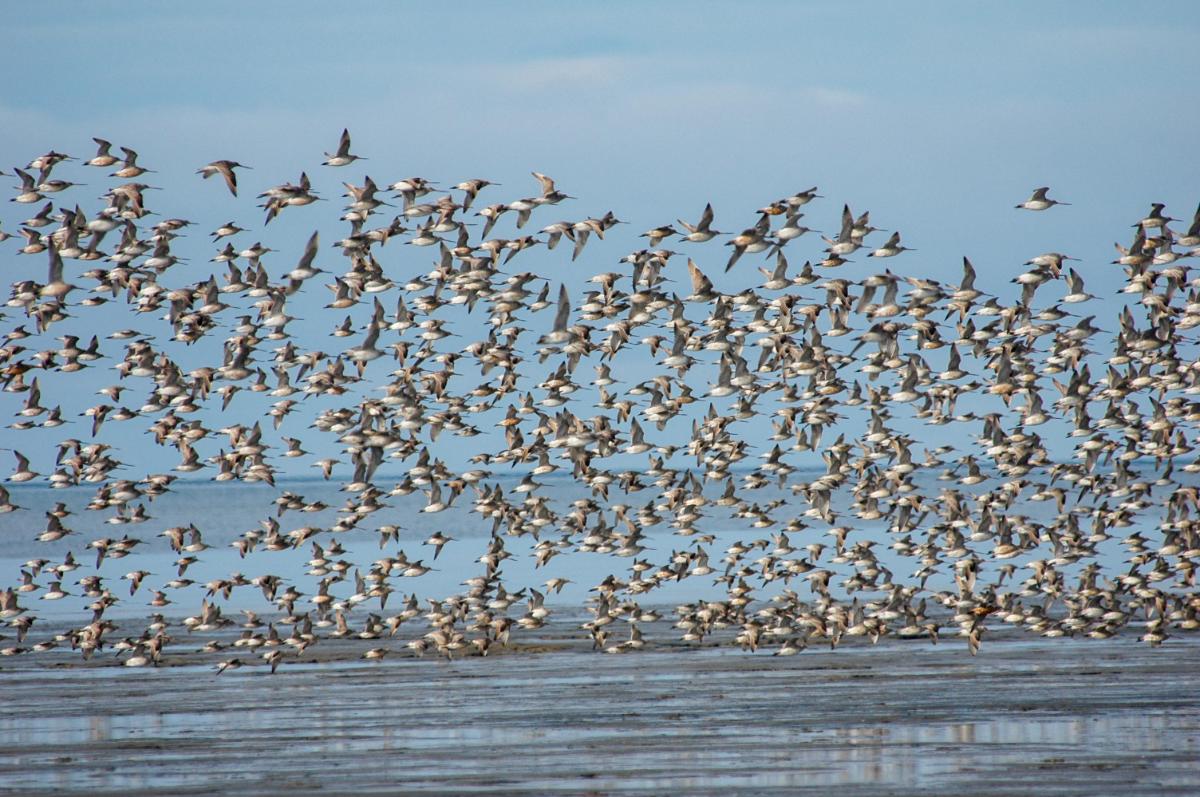

How a five-month-old migratory bird crossed the Pacific Ocean, survived 11 days without landing, and what its incredible journey tells us about bird migration in India.
Imagine taking off from one continent and flying across an entire ocean for 11 days without landing anywhere to eat, drink or rest. For humans, this sounds impossible. For one remarkable bird, it was a documented journey.
In October 2022, a young bar-tailed godwit flew approximately 13,560 kilometres from Alaska to Tasmania, Australia, in a nonstop journey lasting 11 days. Scientists tracking the bird recorded one of the longest nonstop flights ever documented in an animal.
The most astonishing part? The bird was only about four months old.
But this is not just a story about endurance. It is also a story about navigation, survival, changing seasons and the extraordinary journeys birds make across the planet. And there is an interesting connection to India, where bar-tailed godwits are recorded as winter migrants along the coast.
Let's explore this remarkable bird, how it survives such an extreme journey, and where you may be able to spot one in India.
1. What Is a Bar-tailed Godwit?
The bar-tailed godwit, scientifically known as Limosa lapponica, is a medium-to-large migratory shorebird belonging to the sandpiper family.
It spends much of its life moving between northern breeding grounds and coastal wetlands where it feeds during the non-breeding season.
How to recognise it:
- Long bill: Its long, slightly upturned bill helps it find food beneath soft mud.
- Long legs: These allow it to walk through shallow water and tidal mudflats.
- Barred tail: Dark horizontal markings on the tail give the bird its name.
- Seasonal colours: Its non-breeding plumage is generally grey-brown, while breeding birds develop more reddish-orange underparts.
- Body length: Approximately 37–41 centimetres.
Bar-tailed godwits are commonly found around estuaries, beaches, lagoons and tidal mudflats. Their diet includes worms, molluscs, crustaceans and other small invertebrates.
They may appear ordinary when feeding beside a coastal lagoon. Yet some individuals are capable of crossing thousands of kilometres of open ocean in a single flight.
2. The Record-Breaking Journey From Alaska to Tasmania
The bird that captured worldwide attention was identified as B6.
In October 2022, scientists from the US Geological Survey and collaborating research organisations tracked this juvenile bird using a satellite transmitter.
Its journey began near Nome, Alaska, on October 13. It arrived in Tasmania on October 24.
Here are the key details:
| Journey detailRecorded information | |
| Bird | Bar-tailed godwit, B6 |
| Age | About four months |
| Departure | Alaska, United States |
| Destination | Tasmania, Australia |
| Distance | Approximately 13,560 km (8,425 miles) |
| Duration | About 11 days |
| Stops during the recorded flight | None |
The bird travelled across the Pacific Ocean, covering a distance comparable to flying from India to Europe and continuing much farther.
What makes the achievement even more remarkable is that B6 was completing its first southward migration. It had no previous personal experience of making this journey.
Scientists could follow its movements because of the tracking device attached to the bird.
This was not simply a viral photograph or an estimate based on its appearance. The journey was documented through scientific tracking.
Scientific source: U.S. Geological Survey — Juvenile Bar-tailed Godwit B6 Sets World Record
3. How Can a Bird Fly for 11 Days Without Food or Water?
The secret is a combination of preparation, physiology and favourable flying conditions.
It stores energy before departure
Before a long migration, bar-tailed godwits feed intensively. They build up fat reserves that act as fuel during the journey.
Unlike a bird making a short flight between two lakes, a godwit preparing for an ocean crossing must carry enough stored energy to sustain continuous flight over an enormous distance.
Its body prepares for the journey
Research on migratory birds shows that their bodies can change before departure. Godwits build up fat reserves, and the relative size of some digestive organs decreases while flight muscles remain essential for sustained travel.
These changes help them prepare for a journey in which feeding during flight is impossible.
It uses stored energy to produce water
Birds need water to survive, but that does not mean they must drink during every part of a journey.
When the body breaks down stored fat, it produces metabolic water. This contributes to the bird's water supply during prolonged flight.
This does not mean dehydration is impossible. Rather, the bird's physiology and energy reserves help it manage the demands of the journey.
It benefits from favourable winds
Wind conditions can make a major difference to a bird travelling across the ocean.
Migratory birds can time their departures to take advantage of favourable winds, helping reduce the energy needed to cover long distances.
It does not need to land to rest
A bird undertaking a nonstop ocean crossing cannot simply stop on a tree branch or shoreline. Its flight must continue until it reaches suitable land.
Its entire journey depends on preparing adequately before departure and maintaining enough energy to reach its destination.
4. How Do Bar-tailed Godwits Know Where to Go?
One of the biggest questions in bird migration is how birds navigate over enormous distances.
Bar-tailed godwits travel between breeding and non-breeding grounds across different countries, landscapes and oceans. Some populations make journeys that cross the Pacific, while others follow routes through Asia and Australia.
Researchers study several possible navigation mechanisms in migratory birds, including:
- Earth's magnetic field: Birds of several species can use magnetic information as part of their navigation system.
- The sun and stars: Celestial cues may help birds maintain orientation.
- Landscape and environmental cues: Coastlines, geographical features and other signals may help during parts of migration.
- Inherited migration behaviour: Many migratory birds have evolved seasonal movements and directional tendencies that help guide their journeys.
The exact contribution of each mechanism can vary by species and circumstance. Scientists continue to investigate how migratory birds combine these cues during long-distance travel.
The important point is that migration is not random wandering. It is a complex behaviour shaped by evolution, environmental conditions and the bird's biological rhythms.
5. The Migration Routes of the Bar-tailed Godwit
Not every bar-tailed godwit follows the same route.
Different populations breed in different parts of the northern hemisphere and travel to different non-breeding areas.
The Pacific route: Alaska to New Zealand and Australia
Some bar-tailed godwits breed in Alaska and travel south towards New Zealand and eastern or southeastern Australia.
The bird B6 followed this broad Pacific migration pattern, flying from Alaska to Tasmania without stopping.
This route is especially famous for its extraordinary nonstop ocean crossings.
The Asian route: Northern Asia to Southeast Asia and Australia
Other populations breed in northern Russia and migrate through parts of East Asia towards Southeast Asia and western Australia.
These birds use important coastal wetlands and mudflats as feeding and resting areas during migration.
The Yellow Sea region between China and the Korean Peninsula is particularly important to many migratory shorebirds. It provides feeding grounds where birds can rebuild energy reserves during their journeys.
Why these differences matter
A bar-tailed godwit seen in India should not automatically be assumed to have flown from Alaska.
The species contains different populations with different migration routes. The famous Alaska-to-Tasmania flight represents one migration strategy, not the journey taken by every bird of this species.
This distinction is important when discussing the bird's presence in India.
6. When Does the Bar-tailed Godwit Come to India?
The bar-tailed godwit is recorded as a winter migrant in Tamil Nadu.
The broad period to watch for migratory shorebirds in coastal India is October to March, with November to February a useful window for planning a birdwatching trip.
However, arrival and departure dates vary according to the population, location, weather and local conditions. The precise arrival date of a particular bar-tailed godwit cannot be predicted from the season alone.
India is not the principal winter destination for the famous Alaska-to-Tasmania population. Instead, birds recorded in India belong to migratory movements associated with Asian coastal regions.
The State of India's Birds assessment lists the bar-tailed godwit as a winter migrant in Tamil Nadu and classifies its global conservation status as Near Threatened.
This means that protecting the coastal habitats it depends on is important.
Reference: State of India's Birds — Bar-tailed Godwit in Tamil Nadu
7. Where Can You Look for Bar-tailed Godwits in India?
Bar-tailed godwits are coastal birds, so the most promising places to investigate are tidal mudflats, estuaries, lagoons and shallow coastal wetlands.
The following locations offer useful starting points for researching sightings. Their inclusion does not guarantee that bar-tailed godwits are present at a particular site on a particular day.
Point Calimere, Tamil Nadu
Point Calimere Wildlife Sanctuary is an important coastal wetland known for its migratory birds and varied habitats, including mudflats and shallow-water areas.
The wider Tamil Nadu coast has documented records of bar-tailed godwits, making Point Calimere and nearby coastal wetlands worth investigating when planning a birdwatching trip.
Pulicat Lake, Tamil Nadu and Andhra Pradesh
Pulicat is a large coastal lagoon with extensive shallow-water habitats and mudflats. It supports many migratory shorebirds during the cooler months.
Before visiting specifically for bar-tailed godwits, check recent records to establish whether the species has been observed at your intended location.
Gujarat's coastal wetlands
Gujarat has extensive intertidal habitats and coastal wetlands that attract a wide variety of migratory shorebirds.
These habitats may be worth exploring, but recent species-specific observations are essential before assuming that bar-tailed godwits are present.
Kerala's coastal wetlands
Kerala's estuaries, lagoons and coastal areas provide habitats for migratory waders.
Check local bird records and the exact wetland before making a dedicated trip to find this species.
Other coastal locations
The best place to observe a bar-tailed godwit is not necessarily the most famous bird sanctuary. It is the location where the bird has actually been recorded recently and where suitable feeding or roosting habitat is available.
For that reason, checking recent observations is more useful than relying on a fixed list of destinations alone.
8. How to Find Recent Sightings Before You Travel
Bird migration is seasonal, and the presence of a species can change from week to week. If your goal is to photograph a bar-tailed godwit, use recent sightings to plan your visit.
A simple approach:
- Open eBird India.
- Search for the scientific name Limosa lapponica.
- Check recent observations for Tamil Nadu and other coastal states.
- Note the date and exact location of each sighting.
- Check whether the bird was reported by a reliable observer and whether the record includes photographs.
- Contact a local birdwatching group or sanctuary guide if you need help confirming the location.
An older observation can confirm that a species has occurred in a region, but it does not establish that the bird is still there today.
9. What Does a Bar-tailed Godwit Do During Winter?
Migration is only one part of the bird's life. Its behaviour on the ground is equally interesting.
It searches for food in the mud
The godwit's long bill allows it to probe soft sediment for small animals hidden beneath the surface.
It feeds on worms, molluscs and crustaceans, among other invertebrates. The bird can move across exposed mudflats, probing repeatedly to locate prey.
It gathers with other shorebirds
Bar-tailed godwits often feed or rest in groups. At suitable coastal wetlands, they may gather alongside other wading birds.
Large flocks can be especially noticeable when the tide changes and birds move between feeding areas and roosting sites.
It responds to the tides
Tides influence when mudflats become exposed and when they are covered by water.
The availability of feeding grounds therefore changes throughout the day. Godwits and other shorebirds must adjust their feeding and resting behaviour to these conditions.
It changes appearance with the season
During the breeding season, the reddish-orange underparts of many adults become more prominent. Outside the breeding season, their plumage is generally more muted.
This seasonal change can make identification easier or harder, depending on the bird and the viewing conditions.
10. What Threats Does This Migratory Bird Face?
A journey across thousands of kilometres requires more than physical endurance. It also requires a chain of suitable habitats along the route.
Migratory shorebirds face several threats.
Wetland loss: Coastal development and land reclamation can reduce the mudflats and estuaries birds depend on.
Reduced food availability: Changes in sediment, water quality and coastal ecosystems can affect the small animals shorebirds feed on.
Human disturbance: Vehicles, boats, people and other activities can disturb birds while they are feeding or resting.
Climate and environmental changes: Changes to coastal conditions can affect the timing, quality and availability of important habitats.
The loss of a single wetland can affect birds that travel between countries. This is why international cooperation and protection of coastal habitats are essential for migratory species.
11. Tips for Photographing Bar-tailed Godwits in India
For wildlife photographers, a bar-tailed godwit offers several interesting opportunities: feeding behaviour, flock movements, reflections on shallow water and flight photographs.
Here are some practical tips.
- Visit during the right season: Start checking sightings from October, and consider November to February for a planned trip.
- Check the tide: Exposed mudflats can provide excellent opportunities to photograph feeding birds.
- Carry a telephoto lens: A long focal length helps you capture detail without approaching too closely.
- Photograph behaviour, not just appearance: Look for probing, walking, preening, interactions between birds and flock take-offs.
- Use early or late light: Softer light can bring out feather details and create attractive reflections.
- Keep your distance: Avoid chasing birds or forcing them to fly. Migratory birds need to conserve energy for feeding, resting and migration.
- Confirm identification: Similar-looking shorebirds can be difficult to distinguish, particularly in non-breeding plumage. Photograph the bill, tail, legs and overall body shape where possible.
A good wildlife photograph should tell a story about the bird and its habitat without disturbing the animal.
12. Frequently Asked Questions
How far can a bar-tailed godwit fly without stopping?
In October 2022, a juvenile bar-tailed godwit named B6 was tracked flying approximately 13,560 kilometres from Alaska to Tasmania in about 11 days without stopping.
How old was the bird that flew from Alaska to Tasmania?
B6 was approximately four months old when it completed its record-setting flight.
Does a bar-tailed godwit eat or drink during a nonstop flight?
It does not stop to feed or drink during a nonstop ocean crossing. It relies on stored energy, particularly fat, and metabolic water produced by the body.
Does the Alaska-to-Tasmania bird visit India?
The famous Alaska-to-Tasmania journey belongs to a Pacific-migrating population. Bar-tailed godwits also occur in India, but the birds recorded here should not automatically be assumed to follow that same route.
In which months can bar-tailed godwits be seen in India?
They are recorded as winter migrants in Tamil Nadu. October to March is a broad period to investigate, while November to February is a practical window for planning a search. Exact dates vary, so check recent observations.
Where can I look for bar-tailed godwits in Tamil Nadu?
Point Calimere and other coastal wetlands are useful starting points for researching local sightings. Check eBird or local birdwatching records before travelling specifically for the species.
Is the bar-tailed godwit endangered?
The global conservation assessment cited by State of India's Birds classifies the species as Near Threatened. Habitat loss and degradation are among the concerns affecting migratory shorebirds.
What is the difference between a bar-tailed godwit and a black-tailed godwit?
They are different species. The bar-tailed godwit (Limosa lapponica) has a barred tail and is known for its extreme nonstop flights. The black-tailed godwit (Limosa limosa) has a different tail pattern and migration ecology.
Conclusion: A Small Bird With a Remarkable Journey
The bar-tailed godwit is a powerful reminder that some of nature's most extraordinary achievements happen without attracting attention.
A bird weighing only a few hundred grams can cross an ocean, travel for 11 days without landing and reach a destination thousands of kilometres away. Its journey depends on energy stored before departure, remarkable physiological adaptations and the ability to navigate across vast distances.
India is also part of the wider story of migratory shorebirds. Coastal wetlands in Tamil Nadu and other regions provide habitats for birds travelling across international boundaries.
The next time you visit a coastal mudflat, look carefully at the wading birds feeding along the water's edge. One of them may be a traveller that has crossed countries and continents to reach that very spot.
Protecting the wetlands where these birds feed and rest helps ensure that their extraordinary journeys can continue.

💬 Comments (0)
Sign in to leave a comment
No comments yet. Be the first to share your thoughts!