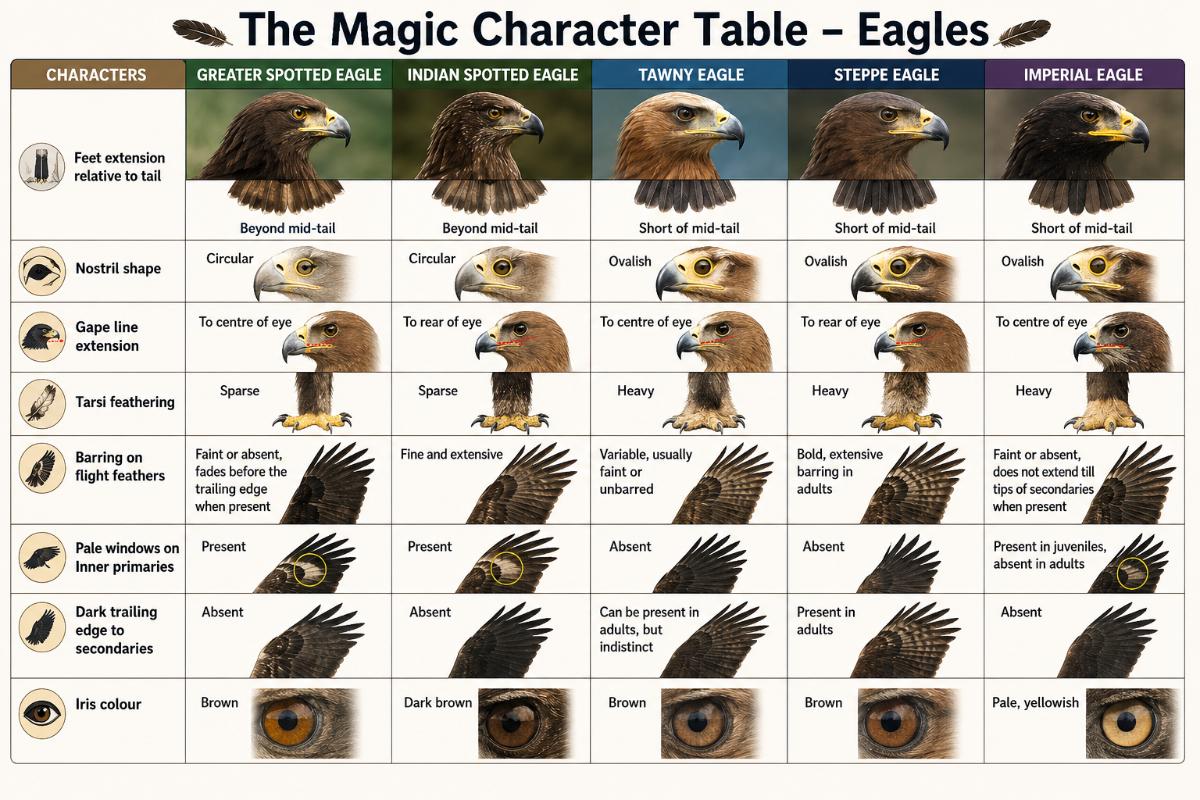

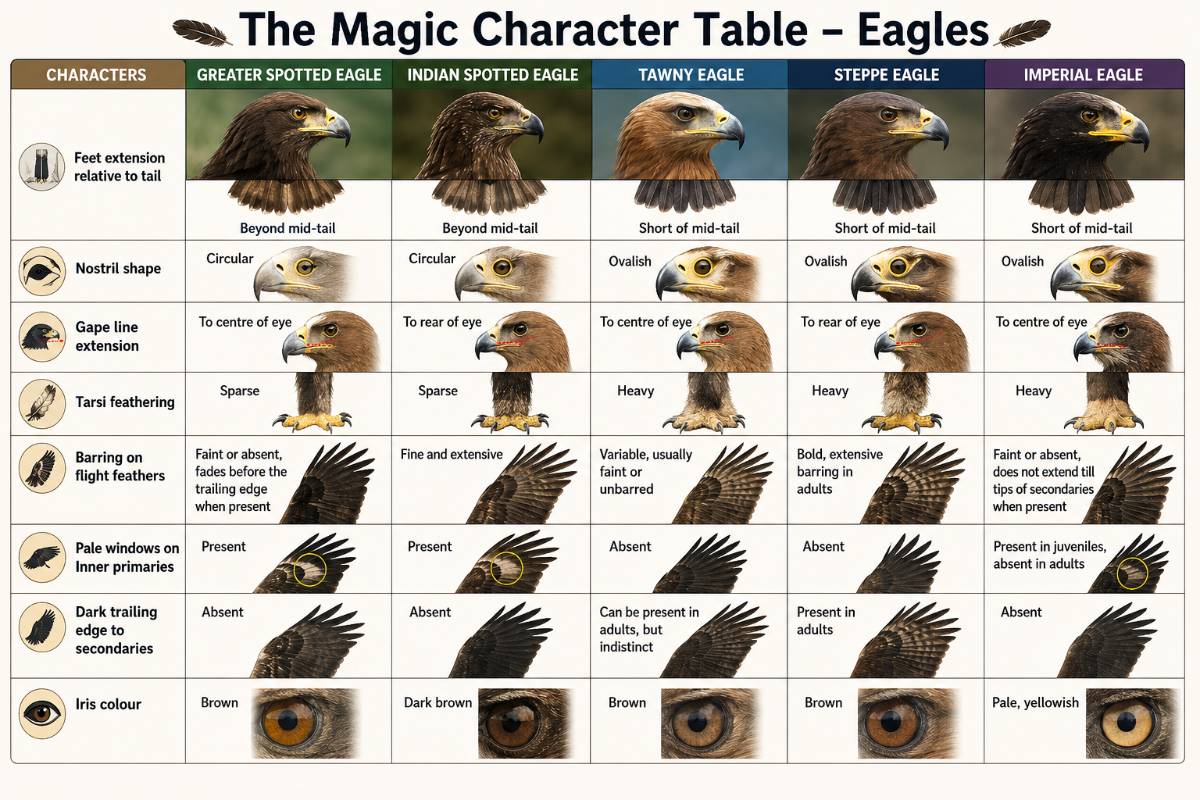
When observing large eagles, especially from a distance, many birdwatchers and wildlife photographers struggle to distinguish between species. Greater Spotted Eagle, Indian Spotted Eagle, Tawny Eagle, Steppe Eagle, and Imperial Eagle often appear remarkably similar in size, shape, and plumage. Fortunately, experienced ornithologists rely on a combination of subtle field marks—often called the "Magic Character Table"—to identify these magnificent raptors with confidence.
Rather than focusing on a bird's overall color, which can vary with age, lighting, and wear, experts examine specific anatomical features that remain relatively consistent across individuals.
Why Identifying Eagles Is Challenging
Unlike brightly colored birds, many eagles display shades of brown throughout their lives. Juveniles and adults can look quite different, while environmental conditions often alter how feathers appear in photographs.
This is why professional birders recommend identifying an eagle using multiple characteristics together, rather than relying on a single feature.
Golden Rule: Never identify an eagle based on one field mark alone.
1. Feet Extension Beyond the Tail


One of the easiest structural clues is how far the eagle's feet extend beyond the tail while perched.
Beyond Mid-tail
- Greater Spotted Eagle
- Indian Spotted Eagle
Short of Mid-tail
- Tawny Eagle
- Steppe Eagle
- Imperial Eagle
Although subtle, this feature is often visible in good perched photographs.
2. Nostril Shape
The nostril shape is surprisingly useful for identification.
Circular Nostrils
- Greater Spotted Eagle
- Indian Spotted Eagle
Oval-shaped Nostrils
- Tawny Eagle
- Steppe Eagle
- Imperial Eagle
This feature is most useful in close-up images.
3. Gape Line (The Line of the Mouth)
The gape line indicates how far the mouth extends toward the eye.
Ends at the Centre of the Eye
- Greater Spotted Eagle
- Tawny Eagle
- Imperial Eagle
Extends to the Rear of the Eye
- Indian Spotted Eagle
- Steppe Eagle
Many experienced photographers use this feature when reviewing high-resolution photographs.
4. Tarsi Feathering
The tarsus is the lower leg of the eagle.
Sparse Feathering
- Greater Spotted Eagle
- Indian Spotted Eagle
Heavy Feathering
- Tawny Eagle
- Steppe Eagle
- Imperial Eagle
This characteristic becomes especially useful when the bird is perched.
5. Flight Feather Pattern


4
Flight photographs reveal some of the most reliable identification features.
Greater Spotted Eagle
- Faint or absent barring
- Bars fade before the trailing edge
Indian Spotted Eagle
- Fine, extensive barring
Tawny Eagle
- Usually faint or no barring
Steppe Eagle
- Bold, extensive barring in adults
Imperial Eagle
- Weak barring that doesn't extend to the feather tips
These patterns are easiest to observe when the wings are fully spread.
6. Pale Windows on the Inner Primaries
"Pale windows" are lighter translucent patches visible on the inner primary feathers.
Present
- Greater Spotted Eagle
- Indian Spotted Eagle
Absent
- Tawny Eagle
- Steppe Eagle
Variable
- Imperial Eagle: Present in juveniles but absent in adults
This feature can often be seen only in strong sunlight.
7. Dark Trailing Edge
The trailing edge of the wing provides another valuable clue.
Absent
- Greater Spotted Eagle
- Indian Spotted Eagle
- Imperial Eagle
Can Be Present
- Tawny Eagle (usually indistinct)
Clearly Present
- Steppe Eagle (adults)
8. Iris Colour
Eye colour changes with age and differs among species.
| SpeciesIris Colour | |
| Greater Spotted Eagle | Brown |
| Indian Spotted Eagle | Dark Brown |
| Tawny Eagle | Brown |
| Steppe Eagle | Brown |
| Imperial Eagle | Pale Yellowish |
Although iris colour alone should never determine identification, it can provide useful supporting evidence.
Tips for Wildlife Photographers
When photographing eagles, try to capture:
- 📸 Side profile of the head (to observe gape line)
- 📸 Close-up of the bill (to check nostril shape)
- 📸 Perched pose (to examine feet extension and tarsi feathering)
- 📸 Wings fully spread during flight (to study barring, pale windows, and trailing edge)
- 📸 Sharp eye close-up (to assess iris colour)
These images will greatly improve your ability to identify similar eagle species after your field session.
Final Thoughts
The beauty of eagle identification lies in the details. While these five species may look alike at first glance, careful observation of structural features, feather patterns, wing markings, and facial characteristics reveals clear differences. By combining several field marks rather than relying on plumage alone, birdwatchers and photographers can confidently identify even the most challenging eagles.
At ShutterChallenge, we encourage every wildlife enthusiast to slow down, observe closely, and let each photograph become an opportunity to learn. The next time you encounter a soaring eagle, remember—the smallest details often tell the biggest story.
📷 Want to improve your bird identification skills?
Explore more wildlife photography guides, identification charts, and community challenges at www.shutterchallenge.com. Happy birding!


💬 Comments (0)
Sign in to leave a comment
No comments yet. Be the first to share your thoughts!