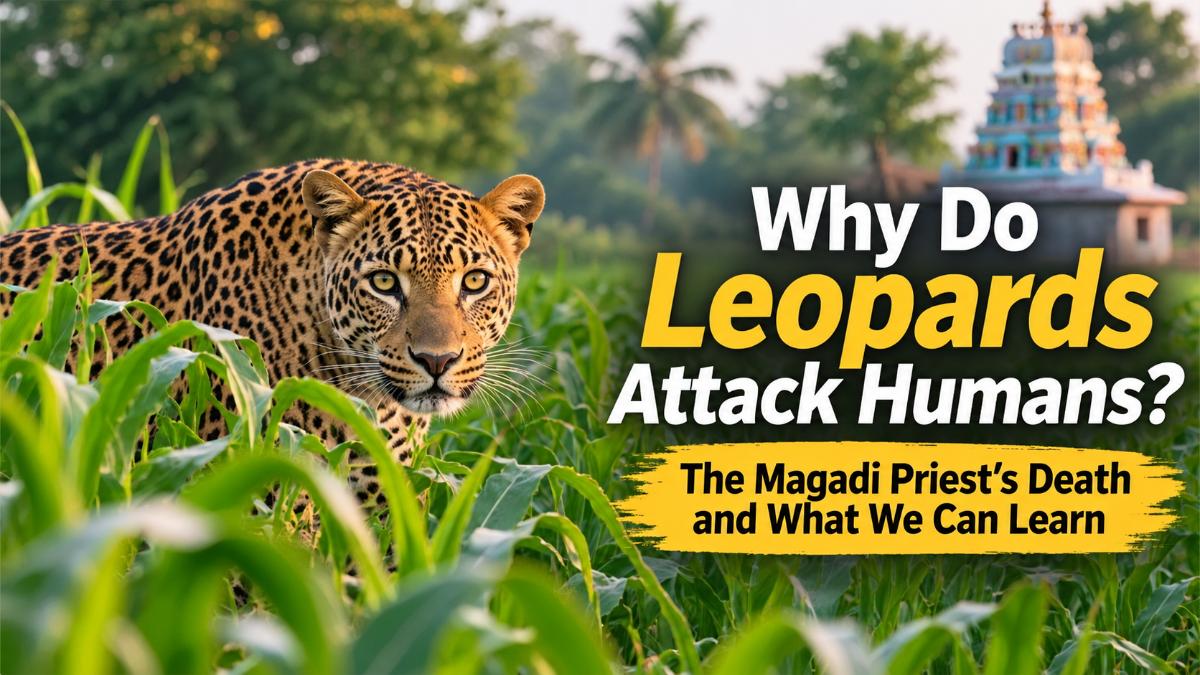

A temple priest went to his agricultural field to collect flowers for his morning prayers. He never returned home. The incident in Magadi raises an important question: if leopards usually avoid humans, why do they sometimes attack?
A Tragic Morning in Kalludevanahalli
On Monday, October 12, 2026, a tragic incident was reported from Kalludevanahalli village in Magadi taluk, Karnataka. Shivaswamy, a village temple priest and farmer, was found dead in his agricultural field following a suspected leopard attack.
According to media reports, Shivaswamy had left home early in the morning to collect flowers for the daily puja at the Mahadeshwara Swamy Temple. At around 6:00–6:45 a.m., he was reportedly in his field when a leopard believed to have been hiding among the crops attacked him.
His body was subsequently discovered by a local resident, and the incident sent shockwaves through the village.
Villagers said leopard sightings and attacks on livestock had been reported in the surrounding area before the incident. They expressed anger over the perceived lack of timely preventive action and demanded that the forest department capture the animal, provide compensation to the bereaved family, and take steps to protect residents.
Forest officials visited the location and initiated action to trace and capture the suspected leopard. However, reports published on October 13 indicated that officials were awaiting forensic findings to confirm the precise cause of death.
This tragedy is not just a local wildlife incident. It raises a question that many people have when they hear about a leopard entering a village or attacking someone working in a field.
Don't leopards normally run away when they see humans?
1. Do Leopards Usually Avoid Humans?
Yes. Leopards are generally elusive animals that prefer to avoid direct contact with humans.
They are adaptable, mostly solitary big cats that often remain hidden during the day and become more active around dusk, at night and during the early morning. When they detect people at a distance, they will often move away quietly rather than confront them.
This behaviour is one reason leopards can live surprisingly close to villages and towns without being noticed.
A leopard may move through agricultural land, hide in bushes or rest in tall vegetation while people carry on with their daily activities nearby.
However, avoiding humans does not mean that a leopard will always retreat safely from every encounter.
The circumstances of an encounter matter enormously.
2. What Happens When a Leopard Is Hiding in a Field?
Imagine a leopard resting in a field of tall crops.
The vegetation provides shade, concealment and a place where the animal can remain undisturbed. It may be resting after moving around during the night or using the field as cover while travelling through the landscape.
Now imagine a farmer or another person entering that field to collect flowers, remove weeds or carry out agricultural work.
The person may not know the leopard is there. The leopard may not detect the person until they are only a few metres away.
Suddenly, both encounter each other at close range.
The leopard may feel threatened or startled and react with a rapid defensive attack. Because leopards are powerful ambush predators, such an encounter can become dangerous within seconds.
This is one possible explanation for attacks on people working in fields and plantations. Research into leopard attacks has documented incidents consistent with defensive reactions when people unexpectedly approach animals concealed in vegetation.
However, we cannot conclude that this was definitely what happened in Shivaswamy's case. The animal's exact behaviour and motivation have not been established publicly.
3. If Leopards Avoid Humans, Why Do They Sometimes Attack?
There is no single explanation for every leopard attack. Several different situations can lead to dangerous encounters.
A. A sudden or unexpected encounter
A leopard hiding in dense vegetation may be difficult to see. When a person approaches unexpectedly, the animal may have little time to assess the situation or move away.
A startled leopard may react defensively, particularly when the person is very close.
B. Feeling trapped or threatened
A leopard that feels cornered, surrounded or unable to escape may become aggressive.
Attempts to chase it away, throw stones at it or crowd around it can make the situation more dangerous.
The safest approach is to give the animal space and an unobstructed route to retreat.
C. Predatory behaviour
Leopards are carnivores that hunt animals for food. In some circumstances, a leopard may attack a human as potential prey.
However, a fatal attack does not automatically establish that the leopard was attempting to hunt or eat the person. Defensive and predatory attacks can sometimes be difficult to distinguish without detailed evidence.
D. The presence of livestock and other food sources
Leopards can survive in landscapes where forests, farms and settlements overlap. Domestic animals and other accessible food sources can attract them to areas used by people.
Once a leopard regularly moves through agricultural land or near houses, the likelihood of an unexpected encounter may increase.
These factors do not mean that every leopard living near a village is dangerous. They show why understanding the circumstances and reducing opportunities for close encounters are important.
4. Why Is the Neck Often Mentioned in Leopard Attacks?
Reports of big-cat attacks sometimes describe injuries to the neck or head. This can be frightening, particularly when the victim is an adult.
Leopards have strong jaws, sharp teeth and powerful forelimbs. An attack on a vulnerable part of the body can cause severe injuries and rapid blood loss.
However, a neck injury alone cannot tell us why the animal attacked. It does not conclusively establish whether the encounter was defensive or predatory.
In the Magadi incident, the precise circumstances and cause of death must be determined through the official investigation rather than assumptions based on the reported injuries.
5. Why Are Leopards Found Near Villages and Bengaluru's Outskirts?
Leopards are highly adaptable. They do not always remain inside protected forests or wildlife reserves.
In Karnataka, landscapes around forest patches, agricultural fields, plantations and expanding settlements can provide routes for wildlife to move between habitats.
Areas around Magadi and the wider Ramanagara region have reported leopard sightings and livestock losses. The presence of surrounding forest patches and suitable cover can contribute to encounters between people and wildlife.
As settlements and agricultural activities overlap with wildlife movement routes, people may encounter animals that were already using the landscape.
It is therefore not always accurate to describe every leopard seen near a village as an animal that has simply lost its way.
Sometimes, the leopard is moving through its usual territory or using available cover. The challenge arises when people and wildlife come into close contact.
6. What Should You Do If You Encounter a Leopard?
Knowing how to respond can reduce the risk of an encounter becoming dangerous.
If you see a leopard at a distance:
- Keep your distance and do not approach it for photographs or videos.
- Do not surround, chase or provoke the animal.
- Give it space to move away.
- Inform the forest department if it is near homes, schools or frequently used paths.
If you encounter a leopard unexpectedly at close range:
- Do not run towards it or attempt to touch it.
- Avoid sudden movements and do not corner the animal.
- If you can do so safely, back away slowly while keeping the animal in view.
- Do not attempt to capture it yourself.
- If it is safe to do so, move into a secure building or vehicle and alert the authorities.
If you regularly visit agricultural fields:
- Take extra care when entering tall crops, dense bushes or areas where leopard sightings have been reported.
- Avoid entering areas where an animal may be concealed.
- Follow local forest department warnings and temporary restrictions.
- Report repeated sightings and livestock attacks promptly.
No precaution can guarantee complete safety, but avoiding surprise encounters and giving wildlife room to escape are important steps.
7. Should Every Leopard That Attacks a Human Be Killed?
After a fatal attack, it is understandable that villagers demand immediate action. Residents need to feel safe in their homes, fields and surrounding areas.
At the same time, decisions about capturing, relocating or, where legally justified, removing a leopard should be based on evidence and an assessment by the relevant wildlife authorities.
The immediate priorities should be to protect people, investigate the incident, identify the animal if possible, and take appropriate measures to prevent another encounter.
Where there have been repeated sightings or livestock attacks, authorities should also communicate clearly with residents, investigate complaints promptly and provide practical safety guidance.
The goal is not to minimise the seriousness of a human death. It is to ensure that the response addresses the actual risk and protects the community effectively.
8. Can Human–Leopard Conflict Be Prevented?
Not every encounter can be prevented, but the risks can be reduced.
Forest departments, village communities and local authorities can work together to:
- Respond promptly to reports of leopard sightings and livestock attacks.
- Identify locations where people and leopards repeatedly come into close contact.
- Warn residents when a potentially dangerous animal is reported nearby.
- Improve livestock protection and encourage safer practices around animal enclosures.
- Educate residents about wildlife behaviour and appropriate responses.
- Investigate serious incidents and provide eligible compensation to affected families.
People should also avoid spreading unverified claims about a particular animal or encouraging crowds to gather around a sighting. Such behaviour can increase risks for both residents and the animal.
Conclusion: Respect Wildlife, but Never Underestimate It
The death of Shivaswamy in Kalludevanahalli is a tragic reminder of the risks that can arise when human activities and wildlife overlap.
Leopards generally prefer to avoid people. Yet a sudden encounter with an animal concealed in crops or bushes can become dangerous, and some attacks may also involve predatory behaviour.
The important lesson is not that every leopard is a threat, nor that a leopard will always run away when it sees a human.
Wild animals are unpredictable, and distance is our best protection.
As communities grow around wildlife habitats, awareness, timely reporting and responsible action by authorities become increasingly important. Protecting people and conserving wildlife are not necessarily opposing goals. With informed decisions and effective prevention, we can work towards reducing the risk of tragedies like the one reported in Magadi.
Sources and further reading:
- The New Indian Express — Man killed in suspected leopard attack in Karnataka's Magadi
- Deccan Chronicle — Leopard kills 62-year-old priest in Magadi
- Cambridge University Press — Research on defensive and predatory leopard attacks
- The Indian Express — Understanding human–leopard conflict and safety measures





💬 Comments (0)
Sign in to leave a comment
No comments yet. Be the first to share your thoughts!