
13 species. 2 genera. A world of brilliant colour.
Few birds make an entrance quite like a Roller.
One moment, it is sitting quietly on a branch, watching the ground below. The next, it launches into the air, revealing flashes of electric blue, turquoise, purple, lilac and chestnut.
That spectacular combination of colour and acrobatic flight has made Rollers some of the most fascinating birds for photographers and birdwatchers around the world.
But here's the interesting part:
Not every Roller looks the same.
From India's familiar Indian Roller to Africa's spectacular Lilac-breasted Roller, and from Europe's migratory European Roller to Indonesia's striking Purple-winged Roller, each species has its own visual signature.
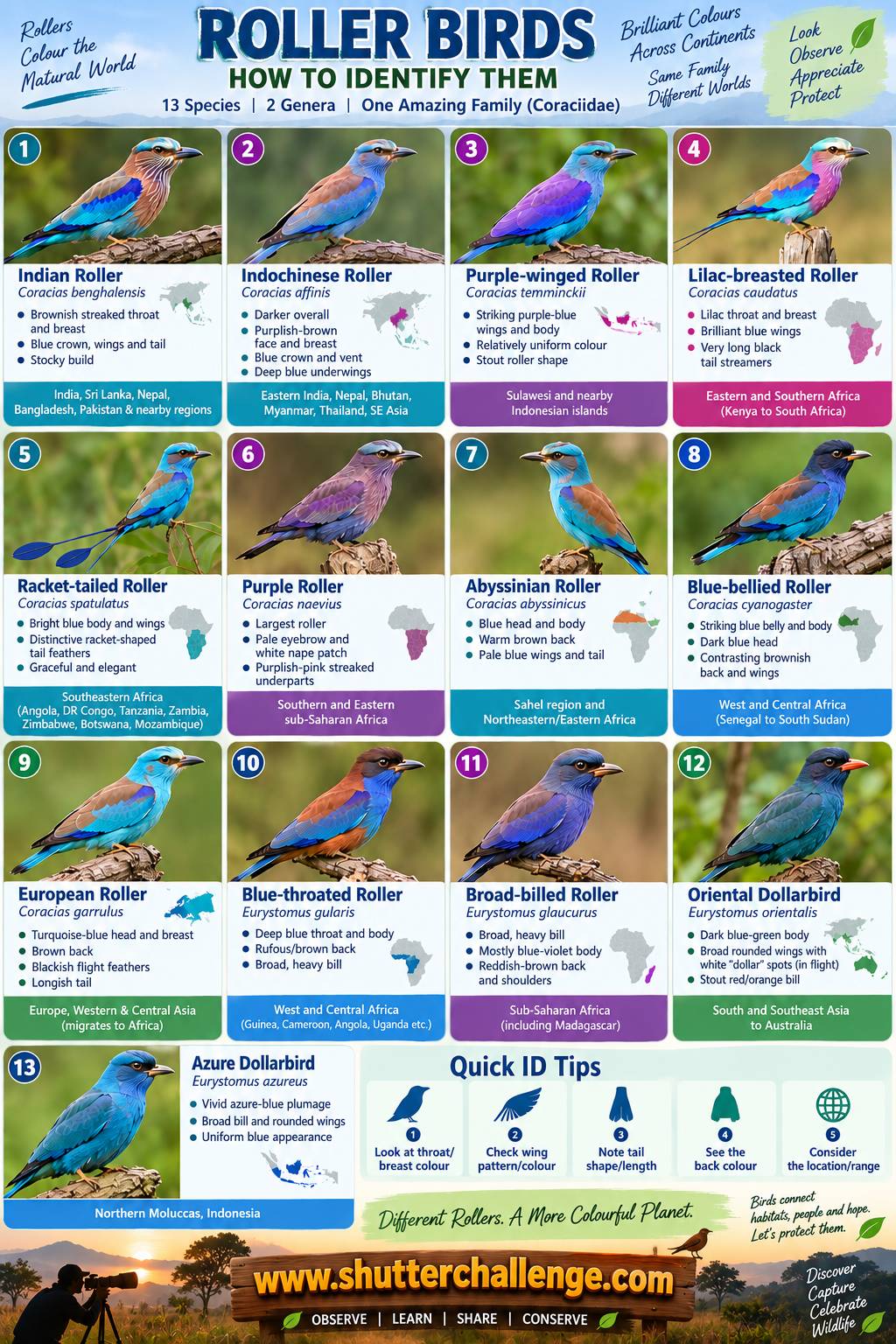
According to the current AviList global checklist, the Roller family (Coraciidae) contains 13 species in two genera.
So, how do you tell them apart?
Let's take a colourful journey around the world.
🔵 First — What makes a Roller a Roller?
Rollers are medium-sized birds best known for their vivid plumage and characteristic flight.
When perched, they can sometimes look surprisingly ordinary.
But watch one take flight.
The wings suddenly reveal intense shades of blue and turquoise, while some species display extraordinary tails, contrasting backs or brightly coloured breasts.
For identification, don't look at just one feature.
Look at five things:
1. Throat and breast colour
Is it brown, blue, lilac, turquoise or purple?
2. Crown and head
The colour of the head can immediately narrow down the species.
3. Wings
Look for bright blue panels, purple tones or contrasting flight feathers.
4. Tail shape
This is especially important for species such as the Lilac-breasted Roller and Racket-tailed Roller.
5. Location
Geography is one of the strongest clues. A Roller photographed in India is not likely to be the same species found in southern Africa.
🌏 Meet the World's 13 Rollers
🇮🇳 1. Indian Roller
Coracias benghalensis
If you are birding in India, this is probably the Roller you are most likely to encounter.
The Indian Roller is famous for its spectacular blue wings and tail, contrasting with its brownish body and streaked throat. When it flies, those brilliant blue wings become impossible to miss.
How to identify it:
Look for the blue crown, turquoise-blue wings and tail, brownish head and breast, and sturdy appearance.
Where: India, Sri Lanka, Nepal, Bangladesh, Pakistan and parts of surrounding regions.
For Indian bird photographers, this is one Roller that can turn an ordinary roadside perch into a spectacular photograph.
🌏 2. Indochinese Roller
Coracias affinis
Very similar to the Indian Roller, but with important differences.
The Indochinese Roller generally has darker and more purplish tones, with a blue crown and stronger blue coloration underneath.
How to identify it:
Look for the darker overall appearance, purplish-brown facial and breast tones and vivid blue crown and underparts.
Where: Eastern India, Nepal, Bhutan, Bangladesh, Myanmar, Thailand and parts of mainland Southeast Asia.
Photographer's clue:
If you are photographing a Roller in northeastern India or Southeast Asia, don't automatically label it an Indian Roller. Check the plumage carefully.
💜 3. Purple-winged Roller
Coracias temminckii
Now things get seriously colourful.
The Purple-winged Roller is associated with Sulawesi and nearby Indonesian islands and is instantly striking because of its rich blue and purple coloration.
How to identify it:
Look for the strong purple-blue wings and body, relatively uniform coloration and stout Roller shape.
Where: Sulawesi and nearby Indonesian islands.
This is one of those birds where the name almost feels like a description written by a photographer.
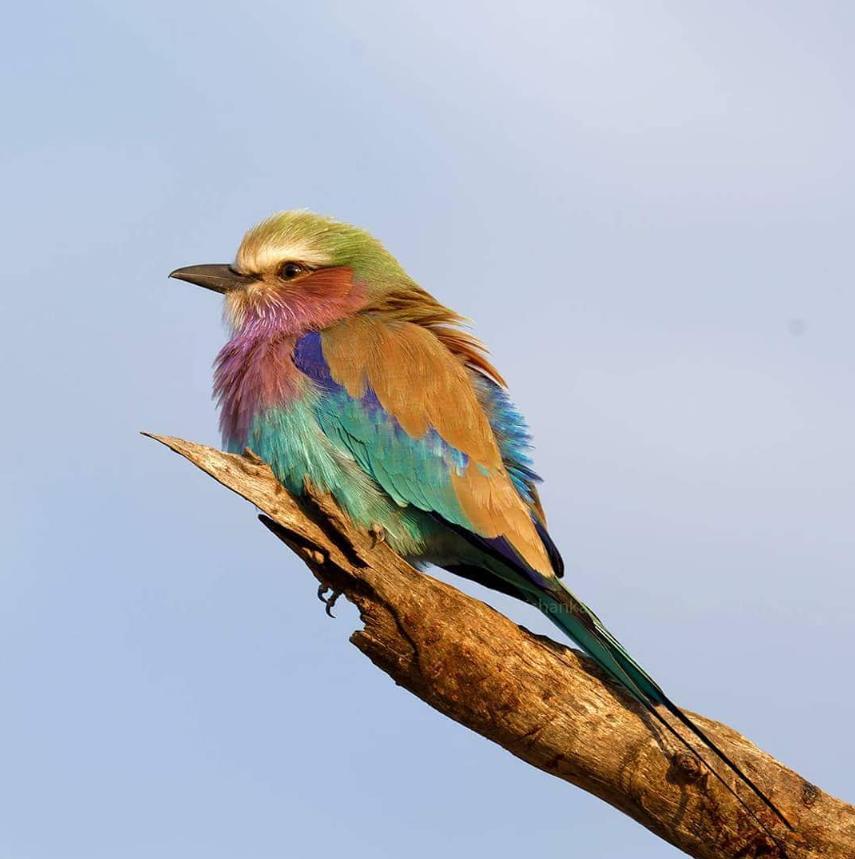
💗 4. Lilac-breasted Roller
Coracias caudatus
One of Africa's most iconic birds.
The Lilac-breasted Roller combines a lilac or purple breast with turquoise-blue wings and a distinctive long tail.
And when it flies?
The colours explode.
How to identify it:
Look for the lilac breast, turquoise-blue wings and the long black tail streamers.
Where: Eastern and southern Africa, including countries such as Kenya, Tanzania, Uganda, Zambia, Zimbabwe, Botswana, Namibia, Mozambique and South Africa.
Photography tip:
A flight shot can reveal much more colour than a perched photograph.
💙 5. Racket-tailed Roller
Coracias spatulatus
The name gives away its most obvious feature.
The Racket-tailed Roller has extraordinary elongated tail feathers ending in racket-shaped tips.
How to identify it:
Bright blue body and wings + unmistakable racket-shaped tail feathers.
Where: Southeastern Africa, including parts of Angola, the Democratic Republic of the Congo, Tanzania, Zambia, Zimbabwe, Botswana and Mozambique.
If you see those unusual tail feathers, you've probably found one of the easiest Rollers to identify.
💜 6. Purple Roller
Coracias naevius
The Purple Roller is a large African Roller with a more subdued purple and brown appearance compared with some of its brighter relatives.
How to identify it:
Look for its relatively large size, pale eyebrow and white nape patch, together with purplish-pink and streaked underparts.
Where: Southern and eastern sub-Saharan Africa.
This is a great reminder that "Roller" doesn't always mean brilliant turquoise and electric blue.
🩵 7. Abyssinian Roller
Coracias abyssinicus
Another spectacular African species.
The Abyssinian Roller combines a blue head and body with a warm brown back.
How to identify it:
Blue head and body + warm brown back + pale blue wings and tail.
Where: Mainly the Sahel and northeastern Africa, extending through parts of the region southward.
Its strong colour contrast makes it particularly attractive in photographs.
🔷 8. Blue-bellied Roller
Coracias cyanogaster
As the name suggests, the blue is one of the key clues.
The Blue-bellied Roller has a striking blue belly and body, contrasting with a darker head and brownish back and wings.
How to identify it:
Bright blue belly and body + dark blue head + contrasting brownish back.
Where: West and Central Africa.
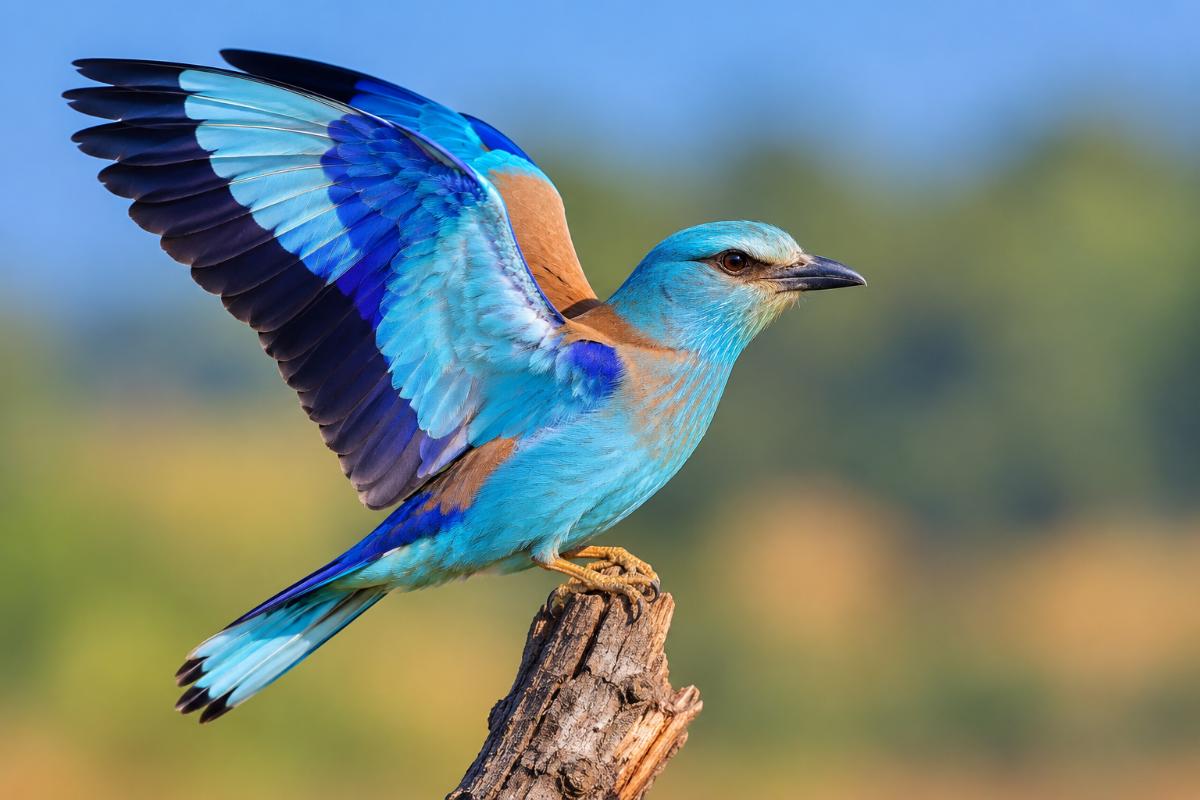
🇪🇺 9. European Roller
Coracias garrulus
The only Roller that regularly brings this family into the European birding conversation.
The European Roller has a beautiful turquoise-blue head and breast, brown back and vivid blue wings.
But there is another important clue:
Migration.
It breeds across parts of Europe and western/central Asia and migrates to Africa for the non-breeding season.
How to identify it:
Turquoise-blue head and breast, brown back, bright blue wings and a relatively long tail.
Where: Europe and western/central Asia, with migration to Africa.
For photographers, migration makes this species particularly interesting because its appearance in a region can be highly seasonal.
🌍 10. Blue-throated Roller
Eurystomus gularis
Now we move into the second Roller genus, Eurystomus.
The Blue-throated Roller is an African species with a deep blue throat and body, contrasted by a rufous-brown back.
How to identify it:
Deep blue throat and body + rufous-brown back + broad bill.
Where: West and Central Africa.
The combination of a heavy bill and deep blue coloration is a useful field clue.
💙 11. Broad-billed Roller
Eurystomus glaucurus
The clue is right there in the name.
Broad-billed.
The species has a broad, heavy bill and predominantly blue-violet plumage with reddish-brown tones on the back and shoulders.
How to identify it:
Broad heavy bill + blue-violet body + reddish-brown back.
Where: Sub-Saharan Africa, including Madagascar.
🟢 12. Oriental Dollarbird
Eurystomus orientalis
This species is slightly different from the typical "Roller" image many people have in their minds.
The Oriental Dollarbird is a dark blue-green bird with a stout red or orange bill.
Its name comes from the distinctive pale circular spots visible on the wings when they are spread — markings that resemble silver coins.
How to identify it:
Dark blue-green body + broad rounded wings + contrasting pale wing spots + red/orange bill.
Where: South and Southeast Asia, extending through parts of East Asia and into Australia.
This is one of the Rollers that photographers should learn to identify from both perched and flying views.
💎 13. Azure Dollarbird
Eurystomus azureus
The final species on our visual journey is the Azure Dollarbird.
Found in the northern Moluccas of Indonesia, it is known for its vivid azure-blue appearance.
How to identify it:
Rich azure-blue plumage, broad rounded wings and a generally uniform blue appearance.
Where: Northern Moluccas, Indonesia.
For bird photographers, this is exactly the kind of species that shows why Indonesia is such an exciting destination for birding.
🔍 The Secret to Identifying a Roller
When you encounter a Roller in the field, don't immediately try to remember every species.
Use this simple method:
👁️ LOOK
Start with the head and breast.
🪽 CHECK
Look carefully at the wings, especially when the bird flies.
🪶 WATCH
Check the tail — length, shape and special feathers can be decisive.
🌍 LOCATE
Ask yourself where you are.
📸 CAPTURE
Take several photographs if possible. A flight shot may reveal features hidden when the bird is perched.
Then compare your observations with a reliable field guide or bird-identification resource.
🌍 A Family Spread Across Continents
Rollers demonstrate how dramatically one bird family can diversify across different landscapes.
Africa is particularly rich in Roller diversity, with numerous species occupying savannas, woodland and open habitats.
Asia is home to species such as the Indian Roller, Indochinese Roller and Oriental Dollarbird.
Europe welcomes the migratory European Roller.
Indonesia adds some of the family's most geographically restricted and visually distinctive species.
Different landscapes.
Different colours.
Different adaptations.
But the same unmistakable Roller spirit.
📷 Why Rollers Are a Photographer's Dream
For wildlife photographers, Rollers offer something special:
Colour + character + behaviour.
A perched Roller gives you the classic portrait.
A take-off shot reveals the wings.
A flight photograph can transform a blue bird into a flying rainbow.
And a carefully timed image of a Lilac-breasted or Racket-tailed Roller can reveal details that the human eye barely notices in real time.
The challenge isn't simply getting the photograph.
It's learning what you're looking at.
That is where bird photography becomes birding.
🌿 Look Beyond the Colours
Rollers are beautiful, but their importance goes beyond photography.
They are part of the ecosystems they inhabit and interact with insects and other prey as predators. Their presence connects us to the health and diversity of the habitats around them.
The more we learn to recognize birds, the more we notice the places they depend on.
And the more we notice those places, the more reason we have to protect them.
📸 See a Roller? Share It.
Have you photographed an Indian Roller?
A Lilac-breasted Roller?
Perhaps a European Roller?
Or one of the species that most birders may never encounter in their home region?
Don't just take the photograph. Learn the bird behind the photograph.
Share your wildlife photography, discover other photographers, and celebrate the incredible diversity of birds with the ShutterChallenge community.
🌎 www.shutterchallenge.com
Capture. Explore. Celebrate. Conserve.
Because every photograph can tell a story.
And sometimes, that story begins with a flash of blue across the sky.
🐦 One Family. Thirteen Species. A World of Colour.
From the Indian countryside to African savannas, European breeding grounds and Indonesian islands, Rollers remind us of one beautiful fact:
Nature doesn't need a paintbrush.
It already knows how to create colour.
Taxonomic note: the current AviList v2025b checklist recognizes 13 species in the family Coraciidae across two genera. Taxonomy and species limits can change as ornithological research develops.
💬 Comments (0)
Sign in to leave a comment
No comments yet. Be the first to share your thoughts!