
Karnataka is famous for its forests, wetlands and wildlife. But hidden among its grasslands and Western Ghats are some incredibly rare birds — birds that even experienced photographers may spend years trying to find.
For a bird photographer, there is a special excitement in seeing a species that very few people ever get to see.
Karnataka is home to hundreds of bird species, from colorful kingfishers and bee-eaters to majestic eagles and hornbills. But beyond the familiar birds are a handful of species that are extremely difficult to encounter.
Some are restricted to tiny habitats. Others have suffered dramatic population declines. And a few are now so rare that every sighting becomes important.
Here are some of the rarest and most remarkable birds associated with Karnataka.
1. Great Indian Bustard — Karnataka's Most Endangered Bird
If there is one bird that deserves to be called Karnataka's most extraordinary rarity, it is the Great Indian Bustard (Ardeotis nigriceps).
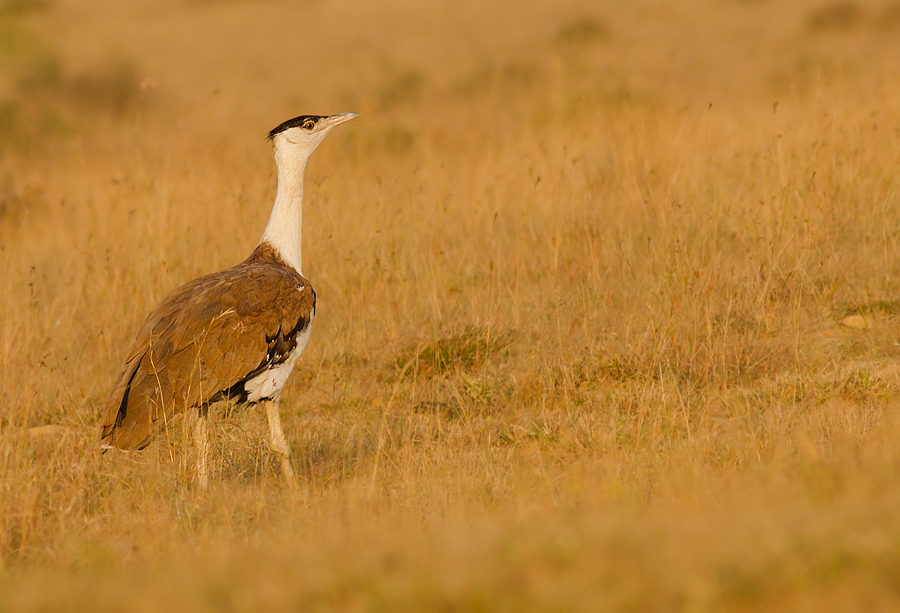
Photo courtesy: Prajwalkm, via Wikimedia Commons (CC BY-SA 3.0)
The Great Indian Bustard is classified as Critically Endangered and is considered one of the world's rarest birds.
This enormous ground-dwelling bird once occupied large areas of India's grasslands. Today, its population has collapsed dramatically, with the remaining birds concentrated in a few isolated areas.
Karnataka's last known stronghold is around Siruguppa in Ballari district, where its remaining habitat is a tiny fraction of its historical range. In 2024, only two individuals were reported from the Karnataka population, down from six reported six months earlier.
The situation became even more concerning in 2025, when reports indicated that only one bird had been sighted in Karnataka.
Why is it so rare?
The Great Indian Bustard faces several threats:
The bird's survival is closely connected to the survival of India's remaining natural grasslands.
A dream bird for photographers
Photographing a Great Indian Bustard in Karnataka isn't simply about getting a beautiful photograph.
It is about documenting a species that could disappear from the state.
For a wildlife photographer, even a distant photograph of a wild Great Indian Bustard can become a priceless record.
2. Nilgiri Wood Pigeon — The Elusive Bird of the Western Ghats
The Nilgiri Wood Pigeon (Columba elphinstonii) may not have the same worldwide recognition as the Great Indian Bustard, but for birders exploring Karnataka's forests, it is a fascinating and highly localized species.

Photo courtesy: Michael Hurben, via Wikimedia Commons (CC BY-SA 4.0)
It is a Western Ghats endemic, meaning its natural distribution is closely associated with this mountain range.
It is a large, dark pigeon with a beautiful checkerboard-like pattern on the back of its neck.
That distinctive neck pattern is one of the best ways to identify it.
The species has been recorded from several locations in Karnataka, including parts of the Western Ghats. Historic records also include Nandi Hills, where a relict population has been documented.
Why bird photographers love it
Unlike common pigeons that are everywhere around us, the Nilgiri Wood Pigeon lives mainly in forest habitats and can be surprisingly difficult to locate.
You may hear movement in the canopy long before you actually see the bird.
And when you finally spot one sitting quietly among the trees, getting a clean photograph can be a real challenge.
3. Lesser Florican — Karnataka's Mysterious Grassland Bird
Another extraordinary bird of Karnataka's open landscapes is the Lesser Florican (Sypheotides indicus).
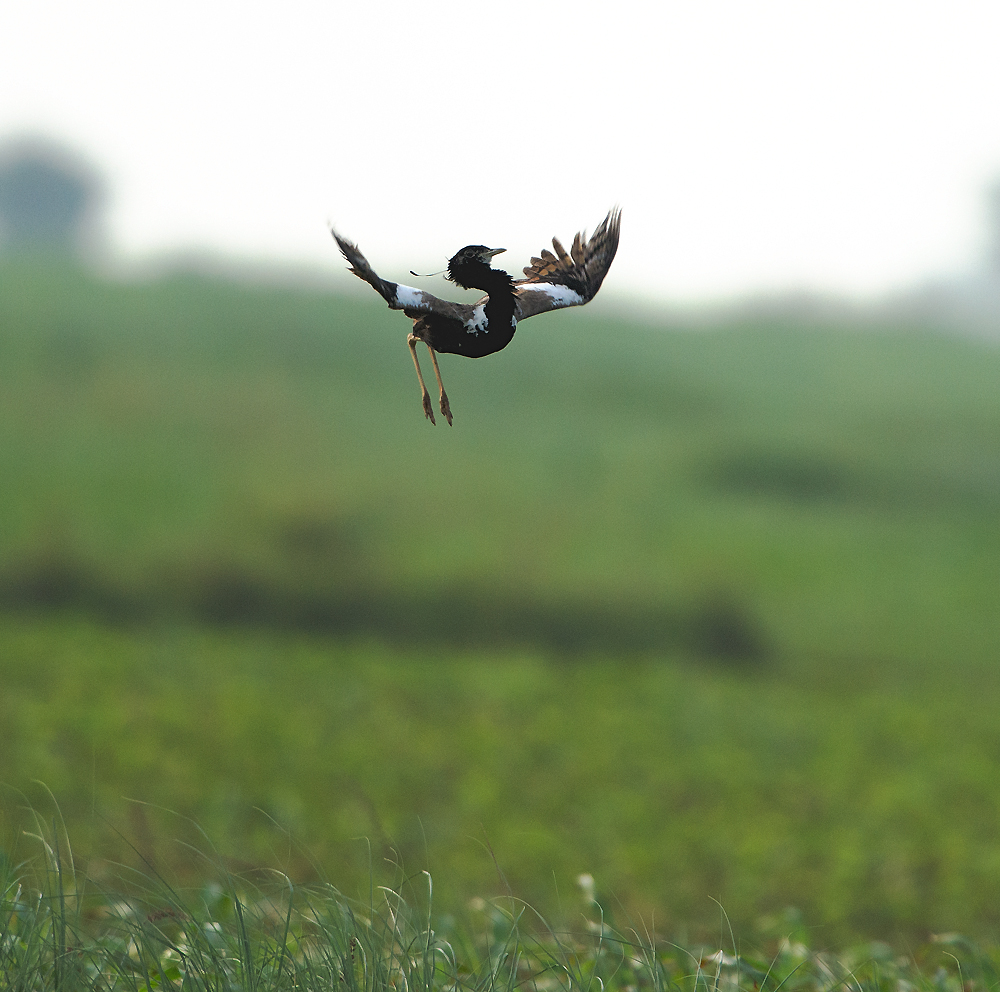
Photo courtesy: Koshyk, via Wikimedia Commons (CC BY 2.0)
This small bustard is particularly fascinating because of its unusual breeding behaviour.
The male is famous for spectacular jumping displays during the breeding season.
But finding one is becoming increasingly difficult.
The Lesser Florican depends heavily on suitable grassland habitat, and the loss and alteration of these open ecosystems have contributed to its decline.
In Karnataka, sightings around the grasslands near Hesaraghatta Lake, Bengaluru, have attracted the attention of birders and conservationists.
Why grasslands matter
When people think about wildlife conservation, forests often receive most of the attention.
But birds such as the Lesser Florican remind us that grasslands are ecosystems too.
Planting trees everywhere isn't necessarily beneficial for grassland specialists. Some species need open landscapes to survive.
Protecting these habitats can therefore be just as important as protecting forests.
4. White-bellied Sholakili — A Tiny Gem of the Western Ghats
The White-bellied Sholakili (Sholicola albiventris) is another special bird for anyone exploring the higher elevations of the Western Ghats.

Photo courtesy: Vijaynivash, via Wikimedia Commons (CC BY-SA 4.0)
It is a small, dark-blue bird with contrasting pale underparts and a distinctive appearance.
Unlike the giant Great Indian Bustard, this bird is tiny and easily overlooked.
That is exactly what makes finding one so rewarding.
It is closely associated with the shola-grassland ecosystems of the Western Ghats, making its survival dependent on these unique high-elevation habitats.
For photographers, the challenge is not just finding the bird but getting a clear view through dense vegetation.
A photograph of a Sholakili sitting on a moss-covered branch, surrounded by misty Western Ghats vegetation, can be one of the most beautiful bird photographs in a portfolio.
Why Are Karnataka's Rare Birds Disappearing?
The stories of these birds are different, but there is a common thread.
Habitat.
Grasslands are disappearing. Forest habitats are becoming fragmented. Human development is expanding into natural landscapes. Power infrastructure creates additional risks for large flying birds.
For some species, even a small change in habitat can have a major impact.
The Great Indian Bustard is perhaps the clearest example.
Once widespread across India's dry and semi-arid landscapes, it now survives in a handful of fragmented populations. The Wildlife Institute of India describes it as one of the rarest birds in the world.
For Bird Photographers: The Photograph Is More Than a Picture
Wildlife photography is often about the perfect moment.
The perfect light.
The perfect pose.
The perfect background.
But photographing a rare bird can mean something more.
A photograph can become a record of existence.
Years from now, a photograph taken today may help show where a species lived, what its habitat looked like and how wildlife changed over time.
That is why ethical wildlife photography matters.
Sometimes the best photograph is the one taken from a respectful distance.
Which Is the Rarest Bird in Karnataka?
There is no official ranking declaring one species as "the rarest bird in Karnataka."
However, the Great Indian Bustard stands apart because of its critically endangered status and the extraordinarily small remaining population associated with Karnataka.
The Nilgiri Wood Pigeon, Lesser Florican, and White-bellied Sholakili are also excellent examples of Karnataka's rare and specialized birdlife.
For a bird photographer, however, rarity isn't only about numbers.
Sometimes the rarest bird is simply the one you have spent years searching for.
And in Karnataka, there are still many such birds waiting to be discovered.
The Next Time You Go Birding in Karnataka...
Don't just look for the most colourful bird.
Look at the habitat.
Look at the grasslands.
Look into the forest canopy.
Listen carefully.
Because somewhere in those landscapes may be a bird that very few people have ever photographed.
And if you are lucky enough to see one, remember: you are not just taking a photograph. You are documenting a moment in the life of a species.
Have you photographed one of Karnataka's rare birds?
Share your best bird photographs with the ShutterChallenge community and tell us the story behind the sighting.
Every photograph has a story. Some photographs also help tell the story of conservation.
💬 Comments (0)
Sign in to leave a comment
No comments yet. Be the first to share your thoughts!