
Category: Birding India | Wildlife | Bird Migration
Location: Broken Bridge, Adyar Estuary, Chennai, Tamil Nadu
Date of sighting: October 11, 2026
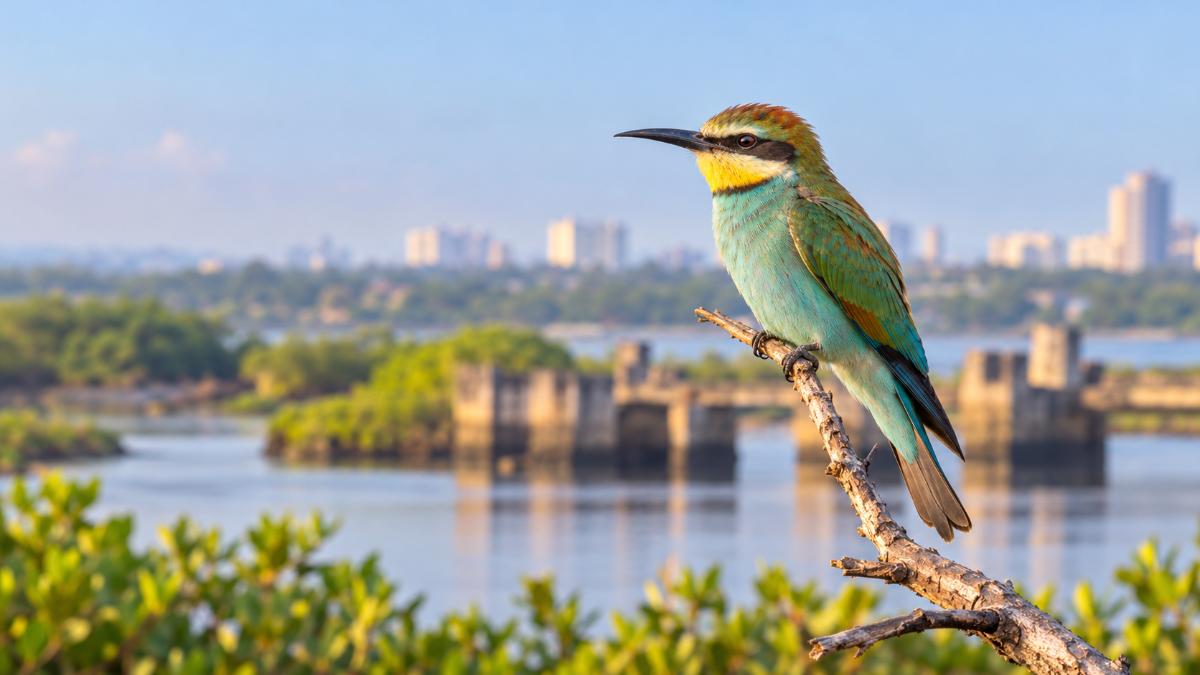
Species: European Bee-eater (Merops apiaster)
An Unexpected Visitor to Chennai
Chennai's coastline witnessed a remarkable moment for birdwatchers on October 11, 2026, when a juvenile European bee-eater was spotted at Broken Bridge near the Adyar Estuary.
The colourful bird, more commonly associated with its breeding grounds across Europe and western Asia, attracted attention because it had not previously been recorded in Chennai, according to reports published following the sighting.
Birdwatchers R. V. Ramanan and his son Shreyas were exploring the area when they initially spotted a pair of Green Bee-eaters. Among the birds, they noticed an unusual individual whose appearance stood out from the species commonly seen around Chennai.
Closer examination and consultation with experienced birders helped establish its identity as a European bee-eater.
The discovery was reported by The Hindu and other news outlets, making it a noteworthy addition to the city's bird records.
Meet the European Bee-Eater
The European bee-eater (Merops apiaster) is one of the most striking birds in the bee-eater family. Its vibrant colours, streamlined body and distinctive long bill make it a favourite among wildlife photographers.
Its plumage features a combination of turquoise-blue underparts, greenish upperparts, a yellow throat and a dark stripe through the eye. Warm chestnut and golden tones can be seen around the crown and back.
Juveniles may appear less sharply defined than adults, but their distinctive colour patterns and body shape can still help with identification.
European bee-eaters are typically found in open countryside, grasslands and other habitats where flying insects are plentiful. They often perch on exposed branches, wires or other vantage points before launching into the air to catch prey.
For bird photographers, this behaviour offers an excellent opportunity to observe their hunting techniques and capture their colourful plumage.
Where Does the European Bee-Eater Usually Live?
The European bee-eater breeds across large parts of Europe and western Asia. Depending on the population, it undertakes long-distance seasonal migrations to reach warmer regions during the non-breeding season.
Many populations migrate to Africa, while observations and research also document the species in South Asia.
In India, European bee-eaters have been recorded in several locations, including parts of Tamil Nadu and Karnataka. Some records suggest that southern India and Sri Lanka are important areas for the species during the non-breeding season.
The timing of the Chennai observation is particularly interesting because October falls within the broad post-breeding migration period identified for the species.
However, the sighting alone cannot establish the bird's exact origin, migration route or destination. Determining these would require further evidence, such as ringing or tracking data.
Research reference: BirdCount India – European Bee-Eater Migration Map
Why Is This Sighting Significant?
A bird's appearance in an unexpected location can be exciting, but its scientific importance goes beyond the excitement of a rare encounter.
1. A new record for Chennai
The October 11 observation was reported as the first recorded sighting of the European bee-eater in Chennai. This is different from being the first record for Tamil Nadu, where the species has been observed elsewhere.
A first documented city record helps improve our understanding of the birds that visit the region and provides a reference point for future observations.
2. A possible clue to migration
October coincides with the species' post-breeding migration period. The Chennai observation may be associated with seasonal movement, but the reason for this individual's presence cannot be confirmed from a single sighting.
Unusual records like this can encourage researchers to investigate migration patterns and seasonal movements more closely.
3. The value of citizen science
Birdwatchers contribute valuable information by recording species, dates, locations and photographs. Platforms such as eBird allow observations to be documented and reviewed, helping build a larger picture of bird distribution.
When unusual sightings are supported by clear photographs and careful identification, they can become useful records for the wider birding community.
European Bee-Eater vs. Green Bee-Eater: How to Tell Them Apart
The initial discovery among Green Bee-eaters makes this sighting especially interesting. Chennai birdwatchers are familiar with the local species, but identifying a similar-looking visitor requires attention to detail.
| FeatureEuropean Bee-EaterGreen Bee-Eater | ||
| Overall appearance | Multicoloured, with turquoise, green, yellow and chestnut tones | Predominantly green |
| Throat | Prominent yellow throat | Usually blue-tinged or turquoise throat with a dark border |
| Crown and back | Often show warmer chestnut and golden tones | Mostly green |
| Body appearance | Generally more colourful, with a blue-green belly | Slender and predominantly green |
| Identification tip | Look for the combination of plumage colours and facial markings | Look for the predominantly green body and characteristic throat pattern |
Colour can vary with age, lighting and photographic conditions, so identification should be based on several features rather than a single colour patch.
Reference: Cornell Lab of Ornithology – European Bee-Eater
Broken Bridge: More Than a Scenic Location
Broken Bridge, near the mouth of the Adyar River, is a familiar location for Chennai's nature enthusiasts and photographers. The surrounding estuary provides an opportunity to observe birds in a landscape where water, vegetation and the urban environment meet.
Coastal wetlands and estuarine habitats can support a variety of resident and migratory birds. Their value depends on factors such as food availability, water conditions, vegetation and the surrounding habitat.
A rare bird sighting is also a reminder that urban nature deserves attention. Protecting suitable habitat, minimising disturbance and documenting wildlife responsibly can help preserve opportunities for future generations of birdwatchers.
Tips for Photographing Rare Birds
Unexpected sightings can be brief, so preparation and responsible behaviour matter.
- Use a telephoto lens: A long focal length helps capture details without approaching the bird too closely.
- Focus on the eye: A sharp eye can make a significant difference to a wildlife portrait.
- Watch the background: Move your position, when practical, to reduce distracting elements behind the bird.
- Observe before shooting: Watching the bird's movements may reveal useful perches, flight paths and feeding behaviour.
- Avoid disturbance: Never chase, surround, bait or flush a bird for a photograph.
- Record the details: Note the date, location, behaviour and identification features. These details can be valuable when submitting an unusual observation.
For rare sightings, a clear documentary photograph can be just as important as an artistic image. It can help other observers verify the identification and establish the circumstances of the encounter.
What Could This Sighting Tell Us About Chennai's Birds?
The European bee-eater's appearance at Broken Bridge is a reminder that birdwatching still holds surprises, even in a large and familiar city.
The observation does not, by itself, prove a change in migration routes or a climate-driven shift in distribution. However, carefully documented records accumulated over time can help researchers investigate whether species are appearing in new places, changing their seasonal movements or simply being noticed more often by a growing birdwatching community.
For Chennai's birders, this was an exciting encounter. For wildlife enthusiasts, it is an invitation to look more closely at the natural world around us.
Sometimes, an extraordinary discovery begins with a routine walk, a familiar bird on a branch and one detail that looks just a little different.
Have you spotted an unusual migratory bird in your city? Share your observation, photographs and location responsibly. Your record may contribute to a better understanding of India's birdlife.
Sources and further reading
- The Hindu – European bee-eater at Broken Bridge
- The Times of India – European bee-eater makes a rare visit to Adyar estuary
- BirdCount India – European Bee-Eater Migration Map
- Cornell Lab of Ornithology – eBird European Bee-Eater species guide
- eBird Status and Trends – European Bee-Eater range map
Editorial note: The Chennai sighting details are based on news reports published in October 2026. The species' broader distribution and migration context are drawn from birding and ornithological references. The precise origin and reason for the individual bird's appearance in Chennai have not been established.




💬 Comments (0)
Sign in to leave a comment
No comments yet. Be the first to share your thoughts!